Eco-Friendly Luxury: How Wara Makes Sustainable Candles | Wara
Share
Wara Journal ·Craft & Sustainability·6 min read
Luxury Without Compromise: How Wara Makes Sustainable Candles in India
Sustainability and luxury are not opposites. At Wara, they are the same decision — made at every step of production, from the wax we choose to the vessel we design to last.
In this article
Why most candles have a sustainability problem
The four principles behind every Wara candle
Materials — what goes into a Wara candle
The vessel as a permanent object
Production — handpoured, small batch, Bengaluru
What sustainable luxury actually means for a buyer
Why Most Candles Have a Sustainability Problem
The candle industry has a materials problem it rarely discusses openly. The majority of candles sold globally — including in India — are made from paraffin wax, a petroleum by-product. When burned, paraffin releases volatile organic compounds into indoor air. The vessels are often single-use glass or tin, designed to be discarded once the wax is consumed.
At the same time, "sustainable" has become one of the most overused and least regulated words in consumer marketing. Brands use it to mean almost anything — recycled packaging, locally sourced materials, or simply the absence of obviously harmful practices.
At Wara, we prefer to be specific. Here is exactly what we do, why we do it, and what it means for the candle that arrives in your home.
"A candle that lasts 50 hours and leaves a vessel worth keeping is more sustainable than ten cheap candles that leave ten pieces of waste."
The Four Principles Behind Every Wara Candle
01
Clean Materials Only
100% pure soy wax. No paraffin, no blends. Cotton and wood wicks — no metal cores, no lead. Fragrance oils selected for indoor air safety.
02
Vessels That Last
Brass, ceramic, terracotta, glass — every Wara vessel is designed as a permanent home object. The candle ends. The vessel remains.
03
Small Batch Production
Every Wara candle is poured by hand in small batches in Bengaluru. No industrial production lines. No excess inventory burned through at discount.
04
Considered Packaging
Packaging designed to be reused or recycled. No unnecessary materials. Nothing inside the box that does not need to be there.
Materials — What Goes Into a Wara Candle
Every material decision in a Wara candle is deliberate. Here is what each component is, why it was chosen, and what it means in practice.
Soy Wax
Derived from soybean oil — renewable, biodegradable, and free of the toxic compounds paraffin releases when burned. Soy wax burns slower and cooler, extending burn time by 30 to 50 percent over paraffin of the same volume. It holds fragrance more evenly and releases it gradually rather than in an initial burst.
Cotton & Wood Wicks
Natural fibre wicks with no metal core and no lead. They burn cleanly, produce minimal soot, and create an even melt pool. Wood wicks additionally produce a soft, quiet crackling that is a sensory feature in itself.
Fragrance Oils
Selected for their compatibility with soy wax and their indoor air safety profile. Fragrance load is calibrated per vessel size to ensure the scent fills the room without exceeding safe concentration levels. No synthetic dyes are added to the wax.
Vessels
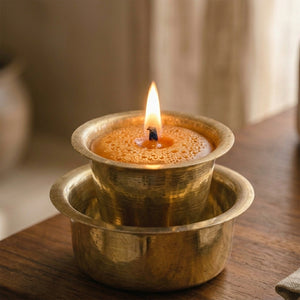
Brass, ceramic, terracotta, glass, and wood — sourced and selected for their longevity as home objects. Every Wara vessel is cleaned and reused after the candle burns down. They are not packaging. They are the product.
The Vessel as a Permanent Object
The most sustainable candle is one whose vessel does not enter a landfill. This is why every Wara vessel is designed as a home object with a life beyond the candle.
The brass Filter Coffee vessel sits on desks across India as a pen holder, a small planter, a decorative piece. The ceramic and terracotta vessels become storage, display objects, and parts of room arrangements. The glass vessels are reused for everything from small flower arrangements to bathroom storage.
This is intentional design, not an afterthought. When Wara selects a vessel, the question is not only whether it holds a candle well. The question is whether it earns its place in a home after the wax is gone.
Production — Handpoured, Small Batch, Bengaluru
Every Wara candle is poured by hand in Bengaluru, in small batches. This is not a marketing claim about craft — it is a production decision with direct sustainability implications.
Small batch production means lower energy consumption per unit than industrial candle manufacturing. It means quality control at every pour rather than reliance on automated processes. It means that when a fragrance or material does not meet standard, the batch is stopped — not shipped and discounted.
It also means that the people making Wara candles are local to Bengaluru, working in conditions that a founder can directly oversee, rather than in a supply chain at a distance.
What Sustainable Luxury Actually Means for a Buyer
For a buyer, sustainable luxury means one thing practically: you are getting something that was made without shortcuts, from materials chosen for quality rather than cost, in a way that causes less harm than the alternative.
Yes — consistently. Soy wax has a lower melting point than paraffin, which means it burns slower and cooler. A 200g soy wax candle typically burns for 40 to 55 hours. A comparable paraffin candle burns for 25 to 35 hours. The difference is not marginal — it is the difference between a candle that lasts a month of regular use and one that lasts two to three weeks.
Place the vessel in the freezer for two hours. The remaining wax will contract and can be popped out cleanly. Wipe the inside with a warm cloth and mild soap. The vessel is now clean and ready for whatever purpose suits it — storage, planting, display, or simply keeping as an object you like having on a shelf.
Significantly safer than paraffin alternatives. Soy wax does not release the volatile organic compounds that paraffin does. The fragrance oils used in Wara candles are selected for indoor air safety. That said, no open flame is entirely without risk — all standard candle safety practices apply, including keeping candles away from the reach of children and pets, and never leaving a burning candle unattended.
Ask three questions. What is the wax — 100% soy, or a blend? What is the wick made from — cotton or wood, or does it contain metal? What happens to the vessel — is it designed to be reused or discarded? A brand that answers all three clearly is one that has made deliberate decisions about materials. Vague answers — "natural wax," "eco-friendly" without specifics — usually indicate the brand does not want to be specific.
Every Wara candle is made from 100% soy wax, poured by hand in Bengaluru, in a vessel designed to outlast the candle. Browse the full collection.